Tuesday, February 3, 2026

Weather Generation 2: What Are We Trying to Match, Anyway?

Last time, I proposed three criteria for weather generation. These are: (1) simulationist: it has to match real world data. (2) algorithmic: I have to be able to generate more tables easily. (3) practical: No more than two dice rolls and two tables.

Today I want to talk about the first bit. How can we tell if a weather system is simulationist?

Throughout this series I’ll be using Chicago as an example. It’s a big city and so should have good data; it has seasons; and I’ve lived there in the past, which should help me identify data that doesn’t add up.

First, I had to get data for real locations. This takes some effort. You can get data from individual weather centers in the US from NOAA. These data, when they exist, seem to be of high quality. But there are oddities. For example, the Chicago dataset has temperature and precipitation since 1946 (albeit with 85% coverage) but only has cloud cover until 1996. So each dataset we use would require some choices and care.

Using local weather stations would also make it challenging to apply anything to places outside the US. The formatting may be different and the data may be less available.

Another option is to use reanalysis datasets. These have already taken data from many local stations, as well things like satellite data, and combined them with weather models to get continuous, global coverage. However, these data can be extensive. One of the best models, ERA5, for example, has a size of tens of terabytes. I ended up not trying to use these.

Instead, I went with data from Open-Meteo, a service which has already pulled some key parameters from ERA5 for easy access. This gives me data of the same type, since 1940, for any location on Earth. Presumably the quality varies somewhat based on how much local coverage went into the ERA5 data? I’d bet the 1940 data are worse, for example. But I think this is sufficient for RPG purposes.

---

So, what do we actually get? The key variables are temperatures, wind speeds, precipitation (snow & rain), and cloud cover. Open-Meteo also provides weather codes by day (e.g., weather code 3 = “Overcast”). At first those seemed helpful, but the distribution wasn’t quite what I expected. For example, for the Chicago summer, the most common weather code I got was Overcast, which was about 10x as likely as Clear Sky. It turns out they are probably set by the most severe weather encountered that day, and that other people encountered similar issues.

I decided to try to set my own weather codes then. I had to decide what to include. Temperature and precipitation are obvious. Cloud cover seemed necessary as well—there is an argument to keep it out because it is not gameable, but I felt it is so important to getting the vibe of a place, and to getting transitions between weather with no precipitation vs with, that I wanted to keep it.

In contrast, I decided not to use wind. Similar arguments can be made in its favor (it precedes rain) and it might be more gameable (-2 to ranged attacks?). But I felt it was less fundamental than cloud cover and 3 variables per day was already a lot. Wind is also complicated, because you have to distinguish gusts vs more steady winds and there might be a need for wind direction. Later on I may revisit it, especially for marine systems where it will be important for sailing.

I was disappointed to not get data for fog. This didn’t seem to be available as a variable in Open-Meteo. Some of the weather codes, at least, indicated fog; but I already noted those were not that reliable. And at the same time, for Chicago at least there were no weather codes that had fog in the past 85 years. Fog isn’t that complicated to add (just yes/no) and is gameable (less visibility) in important ways (good for ambushes, sneaking). So I consider this a real loss. If anyone has any ideas for how to get good fog data in the future I would love to hear them.

---

With those variables, I then set up a categorization scheme. I didn’t want to be too precise, keeping in mind my goal of practicality. A change of 10 degrees F is not that gameable.

I settled on--for temperature, taking the mean temperature each day:

>100 F:          Extreme Heat
>80 F:            Hot
>55 F:             Warm
>35 F:             Cool
>0 F:              Cold
<0 F:              Extreme Cold

For cloud cover, taking the average cloud cover:

>60%:            Overcast
>25%:             Partly Cloudy
<25%:             Clear

And for precipitation, taking the sum across the day:

>0.8” rain:     Heavy rain
>0.2” rain:     Rain
>3” snow:      Heavy snow
>0.3” snow:   Snow
<0.2” rain and 0.3” snow:   No precipitation

If there was both rain and snow, I defaulted to snow. (E.g., 0.3” rain, 0.2” snow would be snow). (NB: I originally tried 0.1”as the threshold for snow, but this led to a Chicago map that was subjectively “too snowy”).

---

I categorized each day into these categories. Then I split them days up by season to figure out the dynamics for each season. (Total, there are 6*3*5=90 possible types of days). Here, for example, is part of the output for Chicago autumn:

Cool / Overcast / None                   0.168862
Cool / Partly Cloudy / None           0.128163
Cold / Overcast / None                   0.108924
Cool / Clear / None                          0.097676
Cold / Partly Cloudy / None           0.081841
Warm / Overcast / None                0.072961
Warm / Partly Cloudy / None        0.064082
Warm / Clear / None                       0.060530


And it continues like that. Total, 34 days are represented, with the rarest occurring 0.015% of the time (1 day across 85 years).

When we think about simulationism, this is the first data we need to match—the day-by-day probabilities of a certain weather state. An authentic weather table for Chicago autumn should have days which are Cool and Overcast with no precipitation about 17% of the time.

---

The second thing we need to match is the transition probabilities: assuming today is Cool and Overcast, how likely is tomorrow to be Cool and Overcast? This is the heart of a ‘realistic’ feeling weather system. So what do those data look like? Across all types of day, something like this:

Here, I shortened the descriptors for each day. The first entry gives temperature:

XC =   Extreme Cold
C =      Cold
L =      Cool
W =     Warm
H =     Hot
XH = Extreme Heat

The second gives cloud cover:

C =      Clear
P =      Partly Cloudy
O =      Overcast

The third gives precipitation:

LS =    Light snow
LR =   Light rain
HS =   Heavy snow
HR =   Heavy rain

If there is no precipitation, that entry is left blank. So XC.C. corresponds to extreme cold and clear.

To read this plot, types of days are given on both columns and rows. You start by finding the row for the current type of day. Then the chance you have of transitioning to another type of day (the columns) is given by the color of that box. The number of times each day appeared in the dataset is given next to the row, in parentheses.

For example, the XC.C. type only appears once. It was followed by a cold, overcast day (C.O.), so that box is dark blue and has a transition probability of 1.

For other days, there are more complex distributions. They are ordered by temperature, with colder days appearing at the top and the left. You can see that generally speaking, days cluster by temperature. Cold days transition to cold days and do not transition to warm ones.

This is a big and complicated object. Keep in mind that we can generate this for any location we want on the planet. So if we determine a good way to match it for Chicago, we should be able to apply that anywhere.

Over the next posts, we’ll see how well we can do.


End note: If we wanted to go even further we could include state information for multiple older days: given it was cold and overcast today and cool and clear today, what will tomorrow be like? I don’t know of any RPG system that attempts this and I think any attempt would be far too detailed to be practical. Still, I note it as a limitation.

Wednesday, November 26, 2025

Adventure Review: Sailors on the Starless Sea

 sss

Adventure Review: Sailors on the Starless Sea

Dungeon Crawl Classics RPG. Level 0. My experience: Run 2x for public games.

A solid mod that doesn't live up to the hype.

Sailors on the Starless Sea is maybe the most popular mod for Dungeon Crawl Classics. It was released when the game came out as a starter funnel and has such widespread acclaim that it got a hardcover edition. I'm reviewing this because I ran it a few times and it worked only ok for me. 

First, an overview: this is a funnel where the PCs play several level 0s each. I love that format and the way it gets people used to running multiple guys. They're sent off to a ruined keep in the wilderness. Inside are beastmen, and there are also some delightfully creepy vine monsters. The PCs have to fight past the beastmen into the keep, descend into the underworld, cross a great lake, and then disrupt a massive ritual. It's a stellar synopsis, a classic plot that gets the PCs into the world. 

I found the keep location the strongest. The PCs have a few different options to get in, then a chance to explore, learn some lore about the place, fight a few more beastmen. Then they've got one way to go--down. I think that's great in a funnel; keep the PCs moving and on track. 

Below ground things required more work. First, there's this location that expands on the vine creatures called "The Summoning Pits". It's evocative and strange and probably great but it just doesn't fit into a 4 hour session. For a home game you can include it but I wouldn't at a con. 

Then, there is crossing the sea. The PCs get a boat they summon and use to get across, and along the way they are attacked by a Leviathan. The Leviathan is brutally difficult, able to TPK the party if they don't either 1) burn luck on their damage rolls or 2) figure out an alternative. The mod has two; they can use some incense they found in the keep (which repels chaos creatures) or they can offer a deliberate sacrifice. 

In my games, they didn't figure out the incense idea. It's just a lot to put together--they have to take incense from the box, use it on the creature up there, then make the connection that it should also affect the Leviathan, which is both much stronger and in a different area. Clever parties might but mine didn't. They also didn't land on the sacrifice idea--once they saw that the Leviathan started eating people, it didn't occur to them that a deliberate sacrifice would have a different effect. 

 So they ended up burning luck. In one case I had to coach them through it, because the group was new, and that was unsatisfying. "Ask the GM how to proceed." 

 The result of these encounters meant that only a couple of PCs got to the final ritual location, a ziggurat. Here, there are dozens of beastmen being whipped into a frenzy--it's clear at this point that the PCs are not going to be able to accomplish anything, in terms of combat or stealth. 

 My players decided to continue, sneaking up to disrupt the ritual anyway. It felt like they stepped out of the game to do so, knowing the adventure was at its climax.  

 I found this section difficult to run, because there were dozens of beastmen and several layers to the ziggurat. Abstracting worked but a lot of pieces. Through some clever play and suicidal actions, the PCs did disrupt things leading to a nice finish. But by the time it was over only one or two PCs lived.

 Overall I found it too involved and just too difficult to be a good con game. If several players are new, running many level 0s is confusing. And, the module has some nontrivial puzzles which have to be solved for a successful conclusion. It is asking a lot for the players to learn to play, to play 4 characters, and to figure out the puzzles all at once.  The lethality of the mod makes it a poor campaign starter because the players won't have enough left to form a level 1 party. 

 I think an experienced GM and a clever (and experienced) group of players could have a great time. But it isn't a great starter mod. For cons, I recommend Tower of the Black Pearl or Citadel of the Scarlet Minotaur or Frozen in Time. As a funnel, I liked Beneath the Well of Brass better. 

Wednesday, November 5, 2025

Weather Generation 1: What I Want in a Weather System

At this blog, we are interested in practical simulationism: rules that get us close enough to reality while maintaining usability at the table.

Weather generation is great for this because:
        -We have tons of weather data for many locations in the world
        -It’s a background system that any RPG could care about
 
        -It feels solvable—there is a best way to do it

The goal of this series is to see if we can come up with a general purpose rule to go from real-world weather data to a working weather table. My criteria are:

        -It has to be simulationist. That means it has to ‘match’ real world weather data from a particular place. How close does the match have to be? We’ll learn more about that as we go through this series.
 
        -It has to be algorithmic. There are tons of cool ideas at there for generating weather in this or that environment. But they can be hard to use because the descriptions are generic. E.g., “Fall weather”, or “Tundra weather table”. It’s much easier as the GM to say: “this environment is like Egypt. Let me use an Egyptian weather table”.
        -It has to be practical. There is a level of taste here. You can create detailed, and probably more accurate, weather if you’ve got a dozen tables and after four rolls you learn that you roll 2d6+2 on subtable C. But this is not useable at the table. I prefer a strict boundary: no more than two rolls, and no more than two tables. A d100 table is two rolls (2d10) and one table—we aren’t going to go much beyond that.

---

So what options are out there for us? First, there are tons of variations on table-based methods. Here is a selection:

(1) Roll on a single table. This is the most popular. I like this version for 5e; here is their table for spring:  


(2) Movement along a table. This is how the Wilderness Survival Guide does it: it sets a range of reasonable temperatures based on environment, then rolls a 2d6 each day to change. If there is a chance of precipitation, you roll on a separate precipitation table (again based on environment).


(3) Multiple tables with jumps. Here for example, you have two tables (basically ‘nice weather’ and ‘bad weather’). Each day you have a 75% to stay on the same table and a 25% chance to jump tables. This adds a bit of constancy.

(4) Independent tables for temperature, precipitation, etc. There is an in-depth version in Dragon #137, by Lisa Cabala, that perhaps gives the apotheosis of this approach. Here is Table 14, for Polar Temperatures. 

A table with text and numbers

AI-generated content may be incorrect. 

        (5) There are also souped-up versions of these which I’d call ‘computer-assisted’ tables. Here is a post corresponding to this spreadsheet. I’ll be honest, I don’t really follow it, but I see they have little dials like a “rain multiplier of 0.8” in early summer. 

A screenshot of a computer

AI-generated content may be incorrect.

Beyond tables, there are there two other systems I’ve seen that are worth mentioning.

(6)  Take a real place, pick a year/time that corresponds to your campaign, then pull weather from a database. I see some people recommend the wundergound database. The idea is, you pick a location corresponding to your desired weather, you pick a year, and then use the day-by-day weather. So maybe my campaign starts on September 7 of DR 1000 (or whatever fantasy system I want). I decide the weather is like Chicago. I pick 1955, arbitrarily. Then the weather on day 1 of my campaign is like September 7, 1955 in Chicago. And I progress day-by-day.

       (7)  Use a hexflower, a hextable with structure to it, where you will move from cell to cell based on a roll. Here is an example. If you go off grid then you loop around, unless you hit an X. These are aesthetically pleasing and have some memory effects to them. 


      So much for the survey. Where do these techniques land from the standpoint of practical simulation?

      First, computer-aided methods are a no go. If you use a computer already maybe it is not that big an ask. But if you don’t, having to start bringing your computer to games, and possibly configuring internet access, just to get weather is not going to happen.

      Second, we should be wary of tables that get too complicated. The Wilderness Survival Guide and Dragon #137 were both comprehensive because they considered a wide variety of possibilities (like ‘Arctic’ --> ‘Hills --> ‘Spring’). This is probably good from a simulationist perspective, but it means flipping pages at the table. (I’ve seen this complaint elsewhere).

      Third, I’d like to quantify how well it matches real weather. This is my biggest source of hesitation with the tables I’ve seen—I can tell the authors have put a lot of thought into their tables, and making them realistic, but I haven’t seen any data in that regard. (Of course doing so would have been way more difficult in the 1980s).

      The third point matters because real locations are how we’re going to orient ourselves with respect to the weather. I want to be able to tell the players “we’re in the Moonsea, so the climate is like Chicago”. That immediately grounds them. Many of the systems seem to use a more vibe based approach—we want there to be more predictability, so we added a mechanic for that.

      It may turn out that simulationism clashes with gamism and using real weather tables means weather that is too constant or too unpredictable or too slow to change or whatever. That’s all well and good—but I’d like to see some proof of that first, which we can only get by comparing to historical data.

Wednesday, October 29, 2025

Adventure Review: Lost Citadel of the Scarlet Minotaur (Levels 1-3)


Adventure Review: Lost Citadel of the Scarlet Minotaur

Shadowdark RPG. Levels 1-3. My experience: Run 2x for public games.

A tight dungeon crawl with room for things to go sideways.

This is the starter mod for Shadowdark RPG, and it comes freely available in the quickstart set. The quickstart set comes with level 1 pregens so it will be fast to get up and running.

I ran this adventure publicly twice, both with three person groups.  

I love the concept and theming. Kelsey based it on the ruins of Knossos on Crete—the original inspiration for the Minotaur myth—and it’s a cool labyrinthine complex. It's what you'd call a "xandered" dungeon, meaning there are multiple entrances and a lot of interconnections within a single level. There are multiple factions—Ettercaps and Beastment—that the players can interact with. They have their own goals and aren't just there to fight, so there's room for negotiation or conflict. The Ettercaps want treasure, which puts them into conflict with the PCs, but can also be a common goal and cause them to become allies. The Beastmen mostly want to hide but have access to secret tunnels that give the players more ways to navigate the dungeon. All of this is great design.

Then there is the minotaur. At a Level 7 creature, it is strong enough to kill or even TPK the party. And, they are bound to encounter it, because it becomes more likely every time they get a random encounter. That gives a fun sense of looming danger. When my players encountered it they ran and we had exciting chases through unexplored areas. You may want to exercise judgement regarding the danger level you want. When the players encounter the minotaur, if it wins initiative and rolls well it can kill someone without them getting a chance to respond. Or you could have it spend a turn bellowing and set off a chase sequence. If you do a chase, they can lose it by staying out of sight for 1d6 rounds, which is a fun dynamic. Its way better than a static boss.

At the same time it is weak enough that the players can overcome it. In one session they got it with help from the Ettercaps—they encountered it as they were leaving the Ettercap lair, having made a deal to join forces to acquire a magic sword. The Ettercaps webs locked it in place and the players hacked it to pieces.

Because there are multiple entrances and factions, every party will have a different experience. I could imagine things going south pretty quickly for an inexperienced party, though. In fact, the very first room on that route has an Ettercap that tries to escape and set up an ambush. If they do, the Ettercaps are strong enough that they can TPK a 1st level party. If the players aren’t careful that could happen fast. My more experienced group scouted the hidden entrances first, checked out the courtyard from above, and had a lot of strategic options. Player skill matters.

All of this is good stuff. One thing I would have liked: one group did a perimeter sweep and asked for the dimensions of the structure from the outside, and there wasn’t much to help from the mod. The labyrinth section isn’t clear about where the tunnel starts on the outside or how it transitions to the inside. In general I never got which parts of the dungeon were underground/above ground, and some artwork of an exterior view, or just some more dimensions, would have helped. I felt bad that I couldn’t give the players a better description there.

Regarding running time, I had a 3 and a 4 hour session and both worked, exploring maybe 50-60% of the dungeon. That was enough time for them to try out multiple entrances and get some of the passageways from the different entrances to line up and match with each other, which was satisfying. It felt like they were learning about this place. It works well as a one-shot even though there is more content than you can complete in a one-shot. 

I had the players map it out themselves which I recommend. It is challenging enough to be fun, and not so hard that they will get hopelessly lost. I had an experienced and an inexperienced mapper and both did fine.  

It is also easy to run as a DM. I spent maybe 30 minutes to an hour reading it and was ready to go. That said it could have done more to set up the motivation. There are these three old kings, each with a powerful magic items (sword, spear, greataxe) present which are a fun goal, kind of like White Plume Mountain, but the players won’t know if they don’t get it on the rumor table. I’d just give them that by default to give them a mission. It would be nice if the mod had listed where each one was up front. 

One final comment: the pregens you get from the quickstart guide seem much stronger, in terms of statline and HP rolls, than you would get with rolled characters. I would use the pregens, or it could be a very difficult mod. 

Overall, running this mod has increased my opinion of Shadowdark. I had run some of the overland content from Cursed Scroll #1 and it didn't work for me. The minimalist approach didn't translate as well to the hexcrawl and I felt like as the GM I had to bring a lot of my own ideas to make it work. But it is much better as a dungeon crawl and I hope to try more of those.

Friday, October 24, 2025

Expedition D&D Dev Log Part 2: Basic Expedition Rules

In the second post, I want to dive into the details of the expedition system itself. Following on the Source of the Nile rules, I want to have two base units you can hire: soldiers and bearers.

Soldiers are going to be pretty much the same by default. I’m thinking of the DCC retainers, maybe amping them up a bit because Simple D&D has higher HP. So I’ll set them at 4 HP, +0 to hit, and dealing damage by weapon (typically d6).  Their armor class is set by whatever armor they wear, and they have zero bonuses to their stats—generic mook-type characters.

Bearers, on the other hand, have no combat abilities at all. If a fight breaks out, they’ll run, scatter, or hide.

Next, I want to establish some carrying capacity limits. I love the way Source of the Nile handles this. Each bearer can carry about 10 units of supplies. Bearers don’t have weapons or armor, so they can always use their full carrying capacity for supplies.

For the soldiers, we’ll make a tradeoff. They will also have a base capacity of 10 units, but their weapons, armor, and other gear will count against that total. If you want to bring along a lot of supplies, you’ll need more bearers, because your soldiers will be partially loaded down with their own equipment.

For the heroes, I’m considering tying their carrying capacity to their strength score, like in Shadowdark. But I’ll put a pin in that for now.

Next, let’s get some numbers for food. Regarding food, I found a few sources from the Roman army; one says between 59 and 78 lb per man per month, while another gives 2.5-2.8 lb/day. I’m going to assume this didn’t change much. As our baseline for supply I’ll approximate 10 units ≈ 100 lb, so we’re at something like 1-2 units of food per unit per week. I decided to keep it simple at 1. Maybe this is generous to our expeditions, but I like how easy it will work in game.

For water, the sources say anywhere from 2-12 L/day (depending on conditions). The daily ration in WWI was 4.54 L/day, Vietnam was 3-5 L/day, but could go to 10 for certain duties. With 1L = 2.2 lb, that is something from 4-10 lbs daily. We’ll be generous again so that our expeditions can stay in the field longer, and say 1 unit of water daily per two individuals. But, we’ll give this multipliers, noting that multipliers up to 8x are historically plausible. Maybe we’ll have some rules to apply these in hot environments.

Finally, I want to make some other decisions about water. First, I don’t want to track containers. Caravaneer did this, and it worked only ok because it was a video game and I can’t imagine doing it by hand. Second, I don’t want to track it while you are along a water source. I like the idea of what this system will do for water tracking. It will be really demanding in terms of weight to carry water, so it will be hard to move away from water supplies. I like that idea and I’m excited to see it play out.

So there are our working Rules:

Bearers: Do not fight. Carrying capacity of 10
Soldiers: HP 4, AC and attacks as equipment (+0 to hit). Carrying capacity of 10.
Food: Each unit eats 1 unit/week
Water: Every two units consumes 1/day. Subject to multipliers of up to 8x according to condition. Do not need to carry if next to fresh water supply.

Thursday, October 23, 2025

Development Log: Expedition D&D (Part 1)

 I'm going to start blogging about the OSR system I'm creating, which I'm calling "Expedition D&D". 

My goal looks back at the long history of adventure storytelling—a genre that stretches all the way back to some of the earliest recorded stories like the Epic of Gilgamesh or the Odyssey. Over time, that tradition evolved through tales like Beowulf or the Arabian Nights. It came to America with Last of the Mohicans and then the pulp fantasy of the 1920s and ’30s, with authors like Robert E. Howard and H.P. Lovecraft. And you can trace that DNA right up to modern adventure films like Indiana Jones or The Mummy.

This kind of adventure storytelling leads directly to what folks like Ben Milton call “adventure gaming”. I love that term because it places these games in the context of that literature and history. The adventure is the heart of Dungeons & Dragons. 

Modern D&D usually focuses on a small cast of characters, one for each player. Each one of these is a hero in their own right. It's like a Mission Impossible team where everyone crucial to the mission.

But the scope of adventure storytelling permits larger parties, which I'll call "expeditions". Think back to the Odyssey: it isn't just Odysseus alone, but Odysseus and his group of soldiers. I also like Michael Crichton's Congo, or Lovecraft's At the Mountains of Madness, or the historic Lewis and Clark expedition (the pair had some 40 people in support). 

---

To make this work, I want a system that supports three types of play. The first is expedition play, which is your overland travel. You're controlling heroes, but also a number of generic soldiers or porters, some perhaps with special abilities, who are part of the journey. Here you'll do hex-crawling: you’re exploring new places, dealing with hazards, managing the morale of your team, ensuring everyone’s fed, and keeping track of resources.

Then there’s the hero play, your classic dungeon crawling. Those smaller scale adventures where the heroes are engaging in combat or exploration within a defined location.

Then, I want to have some support for mass battle play. If you have an expedition with 50 or 100 guys, you might end up in a large combat and the hero play rules won't work. 

---

The simplest part is the mass battle element. For that, I’ll basically start off using the old Chainmail rules. If that ends up being a problem or not fitting perfectly, I’ll adjust from there.

For the hero play, there are a lot of great systems out there—OSR games, Shadowdark, and so on—but I’m going to use one called Simple D&D. It’s something I got from a friend named José. Characters start out strong enough to feel heroic, rather than super fragile at level one, and the progression slows down around level three. That means the heroes can become useful and powerful, but they won’t overshadow the rest of the expedition. They’ll still need to rely on their team and resources.

As for the expedition system itself, I have the least experience there. I'm going to start with the Source of the Nile rules. I actually played that game with one of the original creators, Ross Maker, who was part of the Blackmoor crew. David Wesley was the co-designer, so it has a nice link to RPGs. Source of the Nile is very expedition-focused—you have a hero, some soldiers, bearers, you track food and deal with environmental hazards—and I’ll be building on that as the expedition framework.


Sunday, September 8, 2024

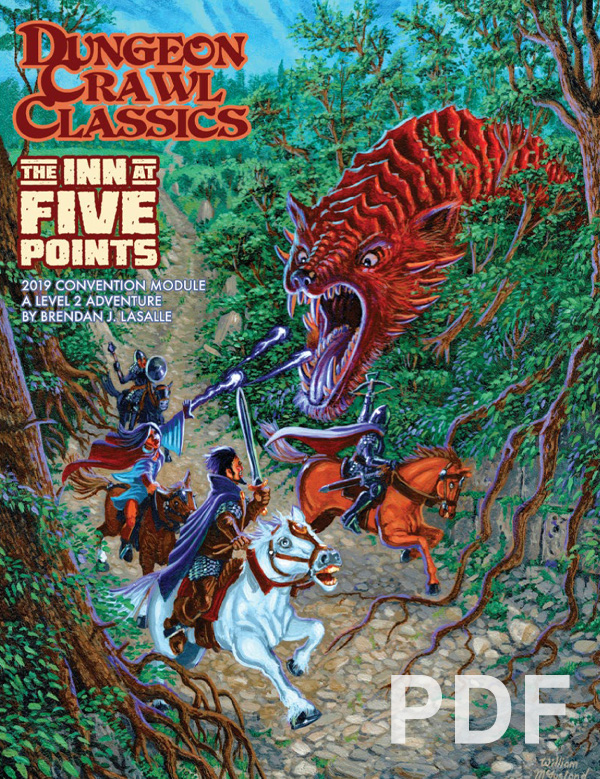
Adventure Review: DCC Convention Module 2019: The Inn at 5 Points (Level 2)


It's a decent convention mod, but there are many better ones in the Goodman Games catalogue. 

The Inn at 5 Points suffers from a lack of direction & a way for players to learn the lore. The first half of the adventure is the journey to 5 points; there's a nice in medias res start battling the beast on the cover (the Wolf Wyrm), a flashback to meet a guy whose party was killed by said Wyrm, then a flash-forward to the combat. The guy tells you someone at the inn has a treasure map for sale, so you head to the titular inn and have a bit of roleplaying. Then in a twist that's in no way foreshadowed, a rat cult completes their ritual, the inn sinks into a massive crevasse, and the players have to defeat the cult.

The individual pieces work. The Wolf-Wyrm is a fun fight, the roleplaying has enough for players to grasp onto, there's a nice place for a break after the inn falls, and the last fight is enjoyable. But it's incoherent as a mod. The rat people are part of a lawful cult that wants to destroy the Inn because the Inn has a reputation for neutrality. But this lore isn't manifested in the plot; you have to use some of the NPCs to give an infodump, otherwise the players will be last. The Wolf-Wyrm isn't connected to the cult at all. At most, it causes the ground to shake when approach, and later shaking in the inn (right before it drops into the crevasse) will be interpreted as a second one approaching. 

There's no real inciting moment or goal. The convention mods that really work (Tower of the Black Pearl, Frozen in Time) start with something for the players to do--a ruin to plunder, a captive to save. In this, you're just wandering through the woods, you get a vague hook (head to the inn to get a map), and the players go along for the ride because they're good sports and get that this is a con game. 

The crevasse itself basically has one big boss fight and some side passages to explore. But in my experience, once the boss fight is over the mod effectively is and I describe the remaining rooms as part of the denouement. 

I made one big change: the guy you meet at the start (Dolmand Frey) wanted to join the party and get the treasure map, giving the players more of a connection to the plot and a possible backup PC. I had them run him as a retainer (level 0) unless someone died, in which case they'd run him as a level 2 warrior. I also made it so he didn't know the contact personally, so the players got to take the lead. 

This took about 3 hours to run, about 90 minutes to get to the inn falling and another 90 for the cavern.

This is $6.99 at the Goodman Games website.

My Experience: I ran this for one con game and for one game with my regular group.

Link: https://goodman-games.com/store/product/dcc-convention-module-2019-the-inn-at-five-points-pdf/

Price: $6.99 (PDF)